

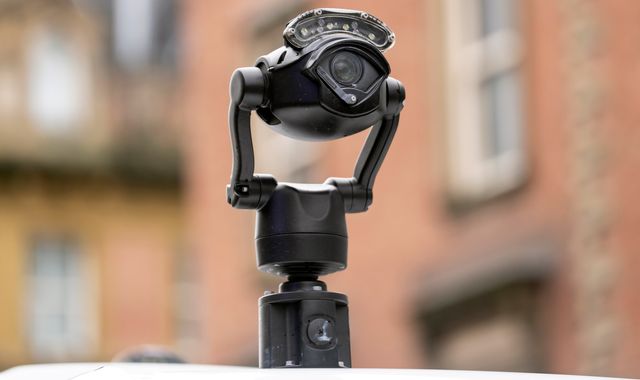
Facial recognition systems will be introduced across the country, the government has said as it welcomed the failure of a legal challenge to the technology.
The case against the Metropolitan Police's use of live facial recognition technology (LFT) in London was brought by two people over concerns it could be used arbitrarily or in a discriminatory way.
The cameras are usually mounted on vans in busy high streets and designed to identify people on police watchlists if they pass by.
Youth worker Shaun Thompson, one of the claimants, said he was misidentified by the technology. The other person bringing the claim was Silkie Carlo, from the group Big Brother Watch.
Their lawyer told the High Court that LFT would also make it "impossible" for Londoners to travel without their biometric data being taken.
But judges ruled on Tuesday that the claimants' human rights had not been breached and the force's policy gave "adequate indication of the circumstances in which LFR will be used".
They also said the argument the technology risked discriminating against people due to their race had not been convincing.
"We are not able to accept, on the thin submissions advanced before us, that concerns about discrimination infect the legality of the policy," said Lord Justice Holgate and Mrs Justice Farbey.
The Met's lawyer told the court at least 801 arrests had been made last year "specifically as a result of LFR" and the privacy risk was "only minimal".
Sir Mark Rowley, the Met commissioner, welcomed the decision and said the tech "helps us catch more criminals quickly and precisely, saves officer time, and ultimately saves money".
He said there had only been about a dozen misidentifications "out of three million people walking past the cameras" and no one had been wrongly arrested as a result.
Policing Minister, Sarah Jones said: "I welcome today's ruling because there can be no true liberty when people live in fear of crime in their communities.
"Live facial recognition only locates specifically wanted people - law abiding citizens have nothing to fear.
"This technology puts dangerous rapists and murderers behind bars - and I question any group who call that uncivil.
"We are rolling out facial recognition across the country with record investment to keep communities safe."
'Stop and search on steroids'
But Mr Thompson said he hoped to appeal and insisted he had been "misidentified, detained and threatened with arrest" due to LFT.
"No one should be treated like a criminal due to a computer error," he said.
"I was compliant with the police, but my bank cards and passport weren't enough to convince the police the facial recognition tech was wrong.
"It's like stop and search on steroids."
The Home Office has previously defended the use of LFR.
It said a person's image is "immediately and automatically" deleted if it does not match the watchlist and all deployments are "targeted, intelligence-led, time-bound, and geographically limited".
Thirteen forces were using it by the end of last year and the home secretary said in January that the number of LFR vans would increase from 10 to 50.
However, Essex Police paused its use of the technology earlier this year after a study found it was "statistically significantly more likely" to correctly identify black people than other ethnicities.
While it was "extremely rare" for someone to be flagged up if they weren't on the list, the force said they was a "potential bias in the positive identification rate".
The force said in March it believed the issue had been fixed by updating the algorithm and the system was ready for the streets again.

(c) Sky News 2026: Facial recognition to be 'rolled out' across UK after human rights challenge fails
 X Factor singer accused of attempted murder makes heart sign from dock
 Boy pleads guilty to arson after attack on synagogue in northwest London
 Man admits raping Sikh woman in racially aggravated attack
 Police update on manhunt after woman's murder in Glasgow
 UK economy: Surprise fall in unemployment rate to 4.9%
 Four tell-tale signs your car has a secret past | Money newsletter
 Police warn people not to carry out arson for money after eight arrested by counter terror police
 Baroness Karren Brady steps down as West Ham vice-chair after 16 years
 Ex-parliament worker arrested under anti-hacking laws by counter-terror police