

The Foreign Office has mounted an unprecedented operation to support British citizens in the Middle East, as airstrikes throw travel in the region into chaos.
Sky News understands UK officials are working on plans for potential routes for the evacuation of tens of thousands, should airspace in the Gulf remain off limits.
As Iran retaliates to US and Israel strikes with counter attacks on military and other targets across the Gulf, major airports have been forced to close for a second day, including the world's busiest international hub in Dubai.
It has sent shockwaves and the most severe business disruption through the Gulf since the COVID-19 pandemic.
The UK Prime Minister Keir Starmer said at least 200,000 British citizens are in the region, including residents, tourists, and those in transit.
Already 94,000 of these - most of them in the United Arab Emirates (UAE) - have registered their presence in the Middle East on an online government platform launched after the conflict began on Saturday.
The majority have been moved to hotels, in what is one of the biggest consular cases the Foreign Office has had to deal with in recent years.
Sir Keir said: "Over the last two days Iran has launched sustained attacks across the region at countries who did not attack them.
"They've hit airports and hotels where British citizens are staying.
"This is clearly a dangerous situation."
British nationals are currently being advised to stay where they are, follow the instructions of local authorities and monitor the Foreign Office's travel advice.
On Sunday the PM also said he would permit the US to use British bases for defensive strikes against Iran. The Liberal Democrats warned against a "slippery slope" that could see the US "drag Britain into another prolonged war in the Middle East".
Follow live: Tehran seeks revenge for supreme leader's killing
Thousands of flights cancelled
More than 3,400 flights were cancelled on Sunday across seven airports in the Middle East, according to flight tracker Flightradar24.
Disruption has hit Doha in Qatar - which handled 54 million passengers last year - as well as Bahrain, Israel, Jordan, Kuwait, UAE and Saudi Arabia.
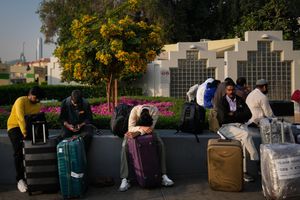
And with airports in Qatar and the UAE often used for connecting flights, the disruption could hamper onward travel plans for passengers across the globe.
Even further afield in Bali, more than 1,600 tourists were stranded after five flights to the Middle East were cancelled or postponed at I Gusti Ngurah Rai International Airport, officials said.
Departures and arrival boards at Heathrow, Gatwick, and Manchester airports, listed multiple flights serving destinations across seven countries as cancelled.
Flight delayed or cancelled? These are your rights
Aviation analyst Cirium estimates that 90,000 passengers per day fly with Emirates, Etihad, and Qatar Airways at Dubai, Abu Dhabi, and Doha alone.
'Drones were exploding in the sky above us'
Jo Hummel, 43, and her husband Chris Jenkins, 46, were travelling back from Thailand with their two children, Ivy, 17, and Kit, 12, when their connecting flight from Doha to London was cancelled.
Ms Hummel, from the Isle of Wight, said: "We touched down into Qatar and people were opening up their phones and there was a national alert coming through in Arabic. We realised something was going on.
"We were transferring in Doha to London and everything was getting cancelled."
She continued: "Qatar [Airways] staff came and offered us a hotel room, at first we were going to stay at the airport, but now we are 20 minutes away in a hotel organised by the airline.
"I had to get them out of bed this morning because drones were exploding in the sky above us and we have big windows. It's quite frightening.
"As a mother, I'm scared out of my wits and trying to keep calm, but also be organised.
"I don't think anything will leave until its safe."
In new travel advice issued overnight, the Foreign Office advised UK nationals against all but essential travel to Bahrain, Israel, Palestine, Qatar and United Arab Emirates.
In a statement, the department said: "British nationals in Bahrain, Israel, Palestine, Qatar and United Arab Emirates can register their presence to receive direct updates from the FCDO on the situation in the Middle East.
"You should continue to follow travel advice and the advice of the local authorities."
Henry Harteveldt, an analyst with Atmosphere Research Group, said: "For travellers, there's no way to sugarcoat this."
They should "prepare for delays or cancellations for the next few days as these attacks evolve and hopefully end", he added.
The strikes on Iran on Saturday led to the death of Iran's Supreme Leader, Ali Khamenei, Iranian state TV eventually confirmed.
In the retaliatory strikes that followed, two UAE airports reported incidents as the government condemned a "blatant attack involving Iranian ballistic missiles".
Officials said four people were injured at Dubai International Airport, while one was killed and seven others were injured in a drone strike at Zayed International Airport in Abu Dhabi.
Also in Dubai, an explosion and subsequent fire occurred near the entrance to the Fairmont The Palm hotel.
Airlines that typically traverse the region may choose to reroute flights, leading to longer travel times, rising fuel costs, and eventually higher ticket prices.
It remains unclear how long disruption will continue, but earlier the US President Donald Trump said fighting in Iran could last "four weeks or so".

(c) Sky News 2026: As Iran strikes close Middle East airports, UK plans for evacuation of tens of thousands
 RAF base in Cyprus hit by suspected drone strike, Ministry of Defence says
 UK terror threat 'absolutely' under review after Iran strikes, defence secretary says
 Trump's war with Iran has become personal for people in Dubai
 Defence secretary reveals details of UK's Middle East operations - including taking down Iran drones
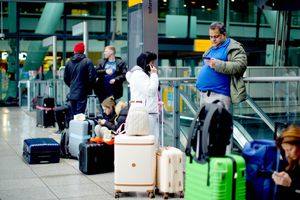 Flight delayed or cancelled? These are your rights to care and compensation
 Man arrested over fatal stabbing at Milton Keynes shopping centre
 Skydiver dies after jump in Devon
 Thinking of paying off student loan early? You should know about expert's £60,000 rule | Money newsletter
 Brits 2026: Olivia Dean dominates awards, winning album of the year
