

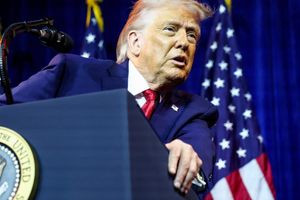
Donald Trump is suing the BBC for $10bn (£7.5bn) for defamation and violation of trade practices.
The US president's 33-page complaint relates to the broadcaster's editing of a speech he made on 6 January 2021, the day his supporters stormed the Capitol building.
Initially, he had threatened to sue for $1bn, but the lawsuit filed in Florida on 16 December is for 10 times more - and more than double the annual revenue raised by the BBC's licence fee in 2023-24.
Here we explain what the lawsuit claims and how the BBC has responded.
What does the lawsuit claim?
The US president is seeking damages of no less than $5bn (£3.7bn) under a defamation lawsuit.
Mr Trump has also sued for $5bn for alleged violation of a trade practices law.
It names the BBC, BBC Studios Distribution and BBC Studios Production as defendants.
The lawsuit stems from an episode of the BBC's Panorama programme titled Trump: A Second Chance?, which was broadcast days before the 2024 US presidential election.
The programme spliced together two sections of the president's speech into what appeared to be one quote.
Mr Trump's lawyers say the programme falsely portrayed the president as a "violent insurrectionist", caused "massive economic damage to his brand value" and was a "brazen attempt" to interfere in the US election.
The Panorama programme was not broadcast in the US, but the lawsuit says it could be watched on the BritBox subscription streaming platform and also claims "millions of Florida citizens use a virtual private network (VPN) to view content such as the Panorama documentary".
It further alleges a Canadian third-party media group called Blue Ant Media Corporation had licensing rights to the documentary outside the UK and distributed the programme "in North America, including Florida".
To overcome the US Constitution's legal protections for free speech and the press, Mr Trump will need to prove not only that the edit was false and defamatory, but also that the BBC knowingly misled viewers or acted recklessly.
How has the BBC reacted to the lawsuit?
The BBC will file a motion to have the lawsuits thrown out, according to court documents.
They say the BBC will claim the Florida court lacks "personal jurisdiction" over it, the court venue is "improper" and that Mr Trump has "failed to state a claim".
The corporation will argue that it did not create, produce or broadcast the documentary in Florida and that Mr Trump's claim that the documentary was available in the US on streaming service BritBox is not true.
The BBC will also claim the president has failed to "plausibly allege" the broadcaster published the documentary with "actual malice".
The broadcaster has asked the court to effectively halt parties from most evidence-gathering, pending the decision on the motion.
A BBC spokesperson said: "As we have made clear previously, we will be defending this case. We are not going to make further comment on ongoing legal proceedings."
BBC News reported on 16 December that the broadcaster had set out five main arguments in a letter to Mr Trump's legal team as to why it did not believe there was a basis for a defamation claim.
It came after the corporation officially apologised to the president in November, adding that the edit was an "error of judgement" and that the programme will "not be broadcast again in this form on any BBC platforms".
A spokesperson said at the time: "The BBC sincerely regrets the manner in which the video clip was edited", but they also added that "we strongly disagree there is a basis for a defamation claim".
The fallout from the saga led to the resignation of both the BBC director-general Tim Davie and the head of news Deborah Turness.
The BBC's position is complicated by the fact that any money it pays out in legal fees or a settlement comes from British taxpayers' pockets.
Could the UK government get involved?
When quizzed on the lawsuit in 2025, Sir Keir Starmer's spokesperson said it was a matter for the broadcaster.
It came after Liberal Democrat leader Sir Ed Davey called on Sir Keir to stand up for the BBC against what he called "Trump's outrageous legal threat".
The prime minister's spokesperson said: "They [the BBC] have made clear they believe there's no case around the broader point of defamation or libel, but that's for them and their legal teams to engage with.
"As we've said previously, we will always defend the principle of a strong, independent BBC as a trusted and relied upon national broadcaster, reporting without fear or favour.
"But as we've also consistently said, it's vitally important that they act to maintain trust, correcting mistakes quickly when they occur."
Asked if it would be acceptable for licence fee-payers to fund a potential defamation settlement, he said: "I think we're getting a bit ahead of ourselves."
Speaking on Mornings with Ridge and Frost in December, health minister Stephen Kinnock backed the BBC.
He said the BBC has apologised for "one or two mistakes" but has also been "very clear that there is no case to answer in terms of Mr Trump's accusations on the broader point about libel or defamation".
Trump's past media battles
During his time in and out of office, Mr Trump has had a contentious relationship with news organisations (mostly US-based ones).
This has led to a host of legal battles. Below is a look at some of the most recent disputes.
Use the slider to scroll and click on the panels for more information.

(c) Sky News 2026: Trump v the BBC: What's in the lawsuit and how has the broadcaster responded?
 Australian author Craig Silvey charged with possessing and distributing child exploitation material
 BBC to file motion to dismiss Trump defamation lawsuit over Panorama edit, court documents show
 Paramount Skydance steps up hostile bid for Warner Bros Discovery with law suit
 Why is Warner Bros for sale and what are the controversial bids?